#include "microlisp_internal.h"#include <stdarg.h>#include <stdio.h>#include <stdlib.h>#include <string.h>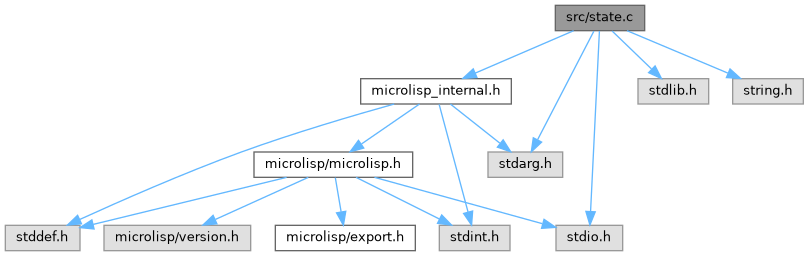
Functions | |
| static void * | default_alloc (size_t size, void *user) |
| static void | default_free (void *ptr, void *user) |
| static microlisp_status | validate_allocator (const microlisp_allocator *a) |
| void | ml_clear_error (ml_state *s) |
| void | ml_set_error (ml_state *s, size_t line, size_t column, const char *fmt,...) |
| const char * | microlisp_state_error (const microlisp_state *state) |
Retrieve a human-readable description of the most recent error on state. | |
| void | microlisp_state_error_position (const microlisp_state *state, size_t *out_line, size_t *out_column) |
Source position of the most recent error, as line and column (both 1-based). | |
| static microlisp_status | intern_special_forms (ml_state *s) |
| microlisp_status | microlisp_state_create (const microlisp_options *opts, microlisp_state **out_state) |
| Create a fresh interpreter state with the built-in primitive bindings loaded in the top-level environment. | |
| void | microlisp_state_destroy (microlisp_state *state) |
| Destroy a state, releasing its GC heap and all interned symbols. | |
| microlisp_status | microlisp_eval (microlisp_state *state, const char *source, size_t source_len, char **out_bytes, size_t *out_len) |
| Evaluate a source buffer of Scheme code as a sequence of top-level forms. | |
| void | microlisp_buffer_free (microlisp_state *state, char *bytes) |
Free a buffer previously returned by microlisp_eval via out_bytes . | |
| static int | fputs_or_fail (FILE *out, const char *s) |
| microlisp_status | microlisp_repl (microlisp_state *state, FILE *in_file, FILE *out_file, const char *prompt) |
Run an interactive Read-Eval-Print Loop reading from in_file and writing prompts and results to out_file. | |
Function Documentation
◆ default_alloc()
|
static |
◆ default_free()
|
static |
◆ fputs_or_fail()
|
static |
◆ intern_special_forms()
|
static |
◆ microlisp_buffer_free()
| void microlisp_buffer_free | ( | microlisp_state * | state, |
| char * | bytes | ||
| ) |
Free a buffer previously returned by microlisp_eval via out_bytes .
NULL is a no-op.
- Lifetime:
- The buffer is allocated by
state'sallocator and must be released before the state is destroyed. Calling microlisp_buffer_free with a state that has already been passed to microlisp_state_destroy is undefined behavior; the allocator'sfreeis no longer reachable through the freed state. The conventional pattern is: eval, consume the result, buffer_free, then destroy the state once you're done with all its outputs.
- Parameters
-
state The state that produced the buffer; the same allocator must be used to free it. bytes Buffer pointer.
◆ microlisp_eval()
| microlisp_status microlisp_eval | ( | microlisp_state * | state, |
| const char * | source, | ||
| size_t | source_len, | ||
| char ** | out_bytes, | ||
| size_t * | out_len | ||
| ) |
Evaluate a source buffer of Scheme code as a sequence of top-level forms.
Each top-level form is read and evaluated in order; the result of the last form is the result of the call. Side effects of earlier forms (defines, set!, displays) persist in state.
- Parameters
-
state Interpreter state. Must not be NULL. source Scheme source bytes. May be NULL iff source_lenis 0 (in which case the call is a no-op returning MICROLISP_OK without_bytesset to NULL andout_lenset to 0).source_len Length of sourcein bytes.[out] out_bytes If non-NULL, receives a pointer to a freshly allocated, NUL-terminated string containing the printed result of the last form (in writestyle: strings quoted, symbols bare). The buffer is allocated with the state's allocator and must be released with microlisp_buffer_free, passing the same state. May be NULL if the caller doesn't need the result text.[out] out_len If non-NULL, receives the length of *out_bytesexcluding the trailing NUL. May be NULL.
- Returns
- MICROLISP_OK on success, or a specific error code.
On any non-OK return, *out_bytes is set to NULL and *out_len to 0; the human-readable error message is retrievable via microlisp_state_error.
- Thread safety: MT-Unsafe. The caller must serialize all calls
- on the same
state.
◆ microlisp_repl()
| microlisp_status microlisp_repl | ( | microlisp_state * | state, |
| FILE * | in_file, | ||
| FILE * | out_file, | ||
| const char * | prompt | ||
| ) |
Run an interactive Read-Eval-Print Loop reading from in_file and writing prompts and results to out_file.
Errors at any form abort that form's evaluation and print a diagnostic to out_file, then the loop continues with the next prompt. The function returns MICROLISP_OK when in_file reaches end-of-file cleanly, or MICROLISP_ERR_IO if a write to out_file fails.
- Parameters
-
state Interpreter state. Must not be NULL. in_file Input stream. NULL means stdin.out_file Output stream for prompts, results, and diagnostics. NULL means stdout.prompt Prompt string printed before each input line. NULL means no prompt (suitable for piped input).
- Thread safety: MT-Unsafe (per state).
◆ microlisp_state_create()
| microlisp_status microlisp_state_create | ( | const microlisp_options * | opts, |
| microlisp_state ** | out_state | ||
| ) |
Create a fresh interpreter state with the built-in primitive bindings loaded in the top-level environment.
- Parameters
-
opts Options. NULL means "all defaults." [out] out_state Receives the new state on success. Set to NULL on error. Caller owns it and must release with microlisp_state_destroy.
- Returns
- MICROLISP_OK on success, MICROLISP_ERR_NOMEM if any setup allocation failed, MICROLISP_ERR_INVALID_ARG if
out_stateis NULL oroptshas a partial allocator table.
- Thread safety: MT-Safe.
◆ microlisp_state_destroy()
| void microlisp_state_destroy | ( | microlisp_state * | state | ) |
Destroy a state, releasing its GC heap and all interned symbols.
NULL is a no-op.
◆ microlisp_state_error()
| const char * microlisp_state_error | ( | const microlisp_state * | state | ) |
Retrieve a human-readable description of the most recent error on state.
The pointer remains valid until the next call into microlisp_eval on the same state, or until microlisp_state_destroy.
For MICROLISP_OK the result is the empty string. Never returns NULL.
- Thread safety: MT-Unsafe (per state).
◆ microlisp_state_error_position()
| void microlisp_state_error_position | ( | const microlisp_state * | state, |
| size_t * | out_line, | ||
| size_t * | out_column | ||
| ) |
Source position of the most recent error, as line and column (both 1-based).
Reports 0, 0 if the error has no associated position (e.g. MICROLISP_ERR_NOMEM) or if state is NULL.
- Thread safety: MT-Unsafe (per state).
◆ ml_clear_error()
| void ml_clear_error | ( | ml_state * | s | ) |
◆ ml_set_error()
| void ml_set_error | ( | ml_state * | s, |
| size_t | line, | ||
| size_t | column, | ||
| const char * | fmt, | ||
| ... | |||
| ) |
◆ validate_allocator()
|
static |